

What Is Human Authored Certification?
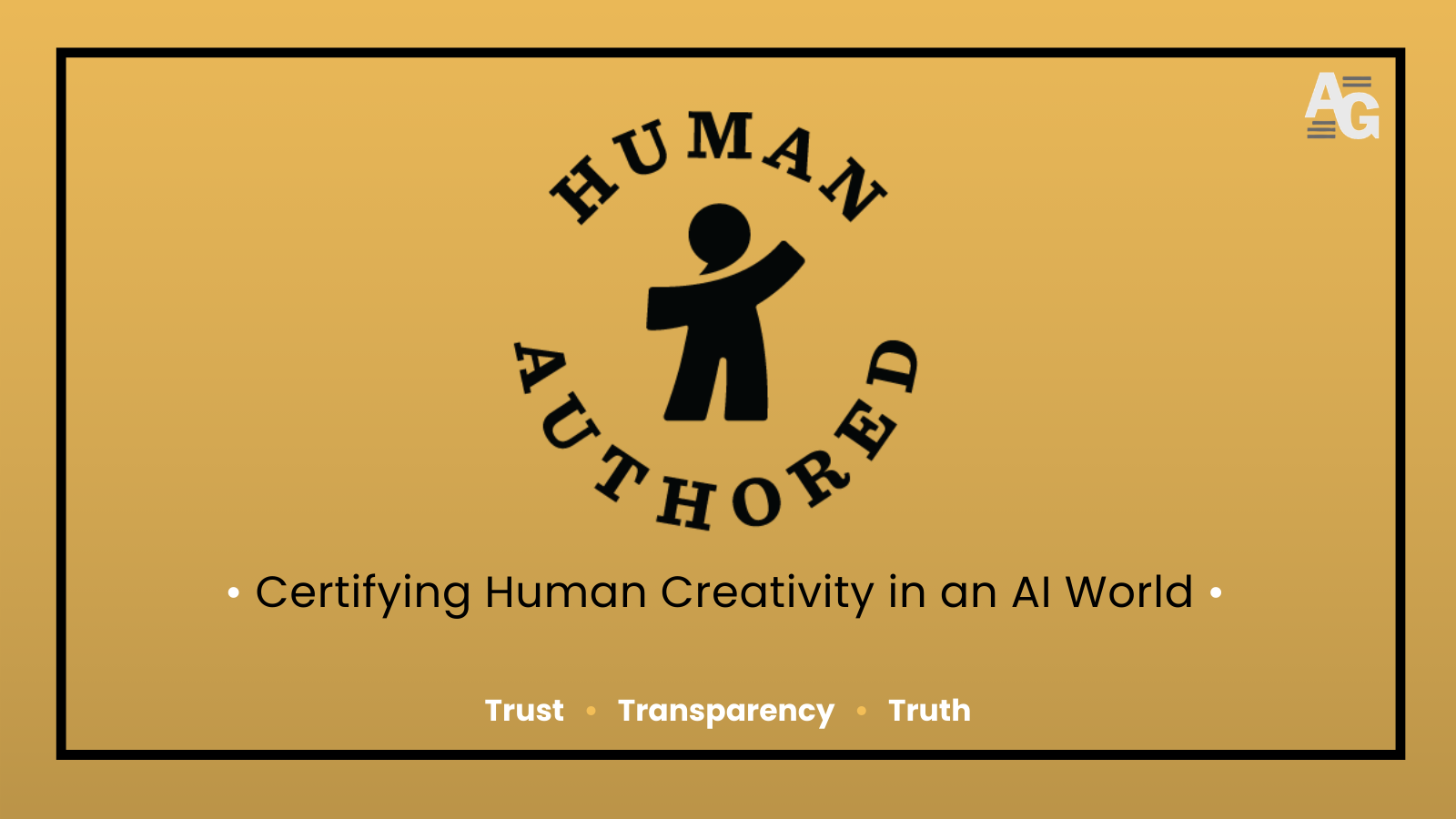
Icon shown above is part of a design created by the Authors Guild for their Human Authored Certification.
Written by Tracy Skochil
Who would have thought the world would get to a point where human authors were encouraged to put a stamp on their book to verify that the words in their book were, in fact, written by a real human. Yet here we are, with the Authors Guild’s Human Authored Certification beckoning.
Questions abound: Do I need it? Is it useful? Can’t people tell I’m a human author without me needing to get certified? There’s a lot to unpack when it comes to AI, authorship, and verification. Read on for local Arizona literary leaders thoughts on the certification, reader preferences for AI stories, and why we shouldn’t bury our heads in the collective sand.
AI / Human Lines are Blurring
Readers don’t want books written by robots, you might be thinking. Yet Waterstones Bookseller’s CEO said he would sell books by AI in his stores, if they were clearly marked (yet there’s no legal push for authors to be transparent) and if that’s what readers want. You might also be sitting there, confident in the fact that you have never once used AI in your work, so you’re fine. But headlines dominated recently about how Hachette, a major book publisher, yanked horror novel Shy Girl from distribution, with all sides saying the other side put AI into the work. Or maybe you’re thinking it’s very clear that I’m a real human, readers can just look at my socials or Google me. We hear you. But you might want to skip down to the Velvet Sundown paragraph.
All things considered, the Authors Guild was forward thinking when they first launched their certification in 2025. It’s received renewed interest in 2026.
What IS Human Authored Certification?
The Authors Guild, America’s oldest and largest community of writers, “advocates for free speech, fair contracts, and copyright.” They launched Human Authored Certification with one goal: “distinguish human creativity in an increasingly AI world.”
How Human Authored Certification Works
Any author with books published in the United States, and who agree to the licensing terms, can apply for Human Authored certification. It’s $10 per title, with ID verification requirements. Both are waived for Authors Guild members. The registration process is fast and easy.
· Create an account
· List whether it’s the work of one human or multiple
· List the title, author name, and optionally list ISBN, ASIN, and publisher
· Review the licensing contract
· Accept the terms
· Wait for acceptance
Once accepted, the certified work will be listed in the publicly accessible Human Authored Database along with the author’s assigned registration number. This database is freely available to the public. Authors also receive a ‘Human Authored’ mark to include on the copyright page of their book and for use in their book marketing, per the Guild’s suggested usage guidelines.
The Elephant in the Certification Room: Verification
Right now, the Authors Guild certification doesn’t run a check on the words within a submitted book to verify if it does or does not use AI. Because determining AI usage is tricky to do at best, dangerous to do if you get it wrong. We’ve all seen cases where everyday people share how they cut and pasted an excerpt from a famous, historical literary classic into an AI detector only to have the AI come back and call it ‘100% AI.’ Take that, Jane Austen and your 73.9% AI-generated Pride and Prejudice.
A recent Jane Friedman article points out the Authors Guild certification “does permit a small amount of AI-generated text, mainly to allow for AI-powered grammar and spell-check applications. Use of AI for research or brainstorming does not disqualify a book, as long as the text is human written.”
The Authors Guild admits as much in its FAQ: “As of now, there is no reliable way to test whether a work includes AI generated material, though this may change in the future. We are using a self-certification system with enforcement against those who misuse our mark, as is typical, and have certain measures in place to prevent use by scammers, such as limits on the number of new titles that can be registered in a year (exceptions will be made with express permission), the issuance of a unique registration number for each title, and a fee for use by non-members.”
Which means there’s work to do when it comes to Human Authored certification. Sure, it’s far from perfect right now, but it’s a start. And ‘a start’ is something we haven’t seen when it comes to legislation requiring those who use AI to author books to reveal themselves.
Should You Get Your Work Certified?
Whether any author should invest in this type of certification depends on a lot of variables, including cost per certification, the time and energy to apply and put the mark into market, whether it’s a point of pride for the author, and whether they see it as setting them apart on bookshelves.
Pro-Certification
Susan Pohlman, editor, writer, and founder of Phoenix Writers Network, sees the certification as strong positioning of an author’s skill. “One of the issues I see with AI generated or AI enhanced manuscripts is that AI tends to flatten voice. The voice of a writer is vital to storytelling. A machine does not understand some of the decisions writers make regarding diction, syntax, and even punctuation at times to create certain effects. A writer crafts a story artfully in a variety of ways. It takes time, craft knowledge, and heart. This should be rewarded and recognized by publishers and the public in general.”
Kathleen Cook, president of the Arizona Authors Association, calls out the value of ID verification for authors. “Having your author identity verified by an established organization is a good idea, since there are so many books and magazines published nowadays under the mask of anonymity (or even deception, in the case of authors who use a more famous pseudonym than their own)." She also applauds the Guild for creating the certification and hopes other groups follow suit as an added perk of membership.
Pro, But Skeptical
At PHX Oasis Press, we meet with a lot of indie authors fighting an uphill battle to build a platform and get their book noticed. If a $10 certification can help someone stand out in a market crowded with AI work (or AI slop), it feels worth testing. The cost is minimal, but the reach is unknown. It’s likely more players will enter the certification game, across geographical boundaries and possibly by platform and publisher. If that happens, what will it cost to manage certification databases, how will those costs be passed on to authors, and will certification become mandatory in future, making it less of a differentiator and more of a table stakes effort?
“It’s honorable, but silly, honestly,” says Kolby Granville, editor in chief of After Dinner Conversation, a popular international lit mag based in Arizona. Granville wonders about the certification’s usefulness. “Are you really going to walk around a bookstore and look for this symbol on the book? And if it’s not there, are you going to assume it is AI generated or simply assume the publisher didn’t go through the process of getting the certification?”
Readers Want Human-Authored Writing … Right?
The Arizona literary experts who participated in this article all firmly believe in the power of human-authored stories. They also firmly believe human-authored stories are what the public really wants to buy. “[Readers] very much are anti-AI and want human authored writing,” says Granville.
Tranise Robinson, owner of Onyx Oasis Bookstore & Author Services, an oasis for Black literature, sees this firsthand in buying habits. “Many readers feel the need to support human created arts to combat AI’s theft of work by human creators.” Robinson also points to the staggering amounts of energy and water AI data centers consume, something the State is seeing plenty of pushback on. “Many readers are environmentally conscious.”
Molly Yin, founder of Lit and Lattes Book Club, would “absolutely care and prioritize human-authored works over AI. When you’re reading a story by a human author, you’re tuning into their creativity and how their mind works.”
But Yin admits there are some AI lines readers might cross. “Readers in our club would most likely not support AI authors, but some might look past it for the perfect romance, or might look past AI-generated book covers.”
Those moments when readers give space to AI generated efforts creates a slippery slope.
The Netflix / Blockbuster Effect
Netflix versus Blockbuster is a famous marketing tale. Blockbuster had thousands of stores, billions in revenue. Netflix, a startup mailing DVDs, was struggling. Netflix approached Blockbuster to partner, but Blockbuster declined. Blockbuster was so set in its belief that customers would always want to go to a store to get movies, they were blind to what was coming. Netflix turned around and capitalized on Blockbuster customer’s frustrations with late fees, out of stock titles, and waiting. Today, there’s only one Blockbuster left, in Bend, OR.
It’s a cautionary tale about potential blind spots we can have when it comes to buyer preference, consumption trends, and spending power.
We can all agree readers love stories. And readers have a strong penchant for human-authored stories. We hope that never changes.
Velvet Sundown – The Band That Wasn’t Real
But what happens when the landscape makes it hard for readers to know who is human on the book shelf, and who isn’t? What happens when people and companies focused on profit rather than craft are let loose in a world that lacks AI regulation yet makes free all the tools of creativity embedded with thousands (millions?) of pirated books to pull from?
Back in 2025, a band called Velvet Sundown raked in more than 1m streams on Spotify. The band released two albums, had a whole backstory, busy social media feeds. Then it came out that Velvet Sundown was an AI creation, “not quite human. Not quite machine … living somewhere in between.” Listeners revolted, once they knew.
Who Are Platforms Recommending To You?
Today, music streaming platforms aren’t legally obligated to make it clear when music is AI-generated. Many sites recommend ‘playlists we think you’ll like,’ and if the listener clicks in, it certainly might sound like something you’d normally listen to. But often, platforms are pushing AI-only playlists and ‘artists,’ unbeknownst to the listener.
What might this look like if it comes to digital book stores ‘recommending’ work that was AI created yet isn’t listed as such, and includes a whole backstory for the AI author? If it’s a good story, many readers might dive in. If they don’t care that it’s AI, no foul.
Yin also wonders if bad actors would try to certify AI-authored works. “There really is no way to verify that all of the works that get certified are actually human authored. With all of the changes in technology in future, I would be concerned about how this certification would remain true to its original intent.”
The Bookstore Battleground
This battle feels like it will play out in physical and digital bookstores across the nation – a landscape that, in wildly positive news, added “about 422 new indie bookshops in 2025” according to the American Booksellers Association.
Indie bookstores have always championed human authors. In Arizona, bookstores and book mobile pop ups host dozens of ‘meet the author’ events, community readings, and book launch parties every month. They are all-in on human-centered storytelling.
So much so that Robinson notes “this certification would absolutely change what I would stock. I’d be more inclined to stock a book that I know is human-authored, instead of a book that I’m unsure of.”
AI & Human Authored Books Sharing Shelves
We can’t ignore the idea of a future where 100% AI works sit alongside human-written works on bookshelves. Waterstones CEO James Daunt hinted at this in December of 2025, quoted in a BBC article as saying he “would stock books created using artificial intelligence … as long as they were clearly labelled, and if customers wanted them.” Daunt did, however, go on to note that he doesn’t expect that to happen.
And while British-based bookseller Waterstones might feel a long way from our valley of the sun, Daunt is also an executive with Barnes and Noble. Decisions he makes carry local impact.
Spending Habits in Tough Economies
Book sales are a hundred-billion-dollar business. Print sales fell 3.1% in the first quarter of 2026. There are a lot of factors at play here, including this quarter’s print numbers being held in comparison against last year’s when there were more books printed due to some blockbuster titles launching. Add to this the fact that inflation is at the highest level in nearly two years. Prices are up everywhere. It costs more to fill up our cars, and book bags. Consumers should have transparency as to which books are AI-authored. If someone chooses to spend their money on AI works, that’s fine. But they should know what they’re buying up front, not after the fact.
In The End, It’s About Transparency
Authors face a new world filled with Human Authored certification, books written by bots, and distribution networks trying to keep up on what readers really want. The Authors Guild Human Authored certification is the tip of a larger AI Transparency iceberg that seems to be revealing itself at a glacial pace. Until legislation comes out that propels AI to identify itself, the next best thing is for authors to make it easier for readers to see our human side, and for authors to support other human authors (and creatives) on this journey.
PS: If you enjoyed this article, and want to support 25 local AZ authors, grab a copy of our newest anthology, The Weight of Almost Knowing from Bookshop.org. Each one of these authors is a real human and we couldn’t be more proud of their efforts. Proceeds from sales help us continue to offer free programs and resources for Arizona authors to build writing and business skills and connect. AND Bookshop.org donates a percentage back to a local indie bookstore.
ABOUT TRACY SKOCHIL
TRACY SKOCHIL’S FICTION EXPLORES THE COMPLICATIONS, CRUELTIES, AND POSSIBILITIES AT THE INTERSECTION OF TECHNOLOGY AND HUMANITY. SHE IS EXECUTIVE DIRECTOR OF PHX OASIS PRESS, A MUSKOKA NOVEL MARATHON GUEST JUDGE, AND HOSTED ONLINE CRITIQUE SESSIONS THROUGH RED SANDS WRITERS CIRCLE. A CANADIAN TRANSPLANT, TRACY LIVES IN GILBERT, AZ WITH HER HUSBAND, PACK OF AUSTRALIAN PUPS, AND A THRILLER SHE IS THIS CLOSE TO FINISHING. FIND HER @TRACY.SKOCHIL.AUTHOR.